
At the end of Week 1, I thought I had figured something out.
I needed to slow down.
That sounds simple, but it went against pretty much every instinct I had when it came to running. If I felt good, I wanted to run faster. If a run felt too easy, I assumed I was not doing enough.
Week 2 started to challenge that thinking.
It also taught me that sometimes the part of a workout that is supposed to make things easier can do the exact opposite.
Starting With Recovery
Sunday started with a walk.
Just over four miles in a little more than an hour, almost entirely in Zone 1.
After the previous week’s runs, it was encouraging that my feet actually felt pretty good. I still had the occasional ache somewhere—a little around the hip, lower shin, or ankle—but nothing that felt significant enough to stop me.
More importantly, I was starting to treat recovery like part of the program instead of something that happened only when I was too sore to run.
I had picked up one of those compression sleeves that goes in the freezer. A couple of times a week, I would put it on one knee while it was still brutally cold, leave it there for four or five minutes, switch knees, and then slide it farther down toward my ankles and feet as it warmed up.
My calves were not really bothering me much, so I mostly left them alone.
None of this was complicated.
Walk. Hydrate. Pay attention to what hurt. Ice things before they became bigger problems.
A few weeks earlier, my recovery strategy was basically just waiting until the next time I felt like running.
This was already different.
An Easy Run Gets Away From Me
Monday’s workout was simple:
Five-minute walk.
Run 1.2 miles continuously.
Five-minute walk.
It was supposed to be an easy run.
Instead, I ran the 1.2-mile portion at about an 11:07-per-mile pace and set a new one-mile best of 11:06 since starting back.
I was pretty happy about that.
There was only one issue.
I was not supposed to be setting a personal record.
Near the one-mile mark, I looked down at my watch and saw my heart rate had climbed above 180. I stopped for a few seconds, got myself back under control, and finished the remaining distance.
Garmin eventually classified the workout as more of a tempo effort than an easy run.
Once again, how the run felt and what the data showed were not quite telling me the same thing.
My legs were saying, This is getting easier.
My watch was saying, You are doing it again.
It was also close to 90 degrees outside, which certainly did not help the heart-rate situation.
Still, underneath all of that was something encouraging.
A distance that had felt like a challenge not long before was starting to feel manageable.
I just had to learn not to turn that improvement into an excuse to immediately run harder.
Paying Attention to More Than Pace
Tuesday was another easy walk.
By this point, though, I was starting to notice that running was becoming more than putting on my shoes and checking how fast I went afterward.
I was paying attention to things I had mostly ignored before.
Breathing was one of them.
I had started experimenting with matching my breathing to my steps, roughly two steps in and two steps out. When the effort picked up, I tried to focus on making the exhale deliberate rather than just letting my breathing get increasingly chaotic.
I was also paying more attention to posture and trying to keep my shoulders relaxed instead of slowly letting them creep toward my ears.
Then there was cadence.
I was not trying to force some magical number. Mostly, I was thinking about taking lighter, quicker steps instead of reaching farther every time I wanted to go faster.
None of this was dramatic.
But I was beginning to understand that pace was only one part of running.
That realization would become more important as the week went on.
The Schedule Changes
Wednesday was supposed to be another run day.
Then I got a migraine.
So the run moved to Thursday.
There was a time when changing the schedule probably would have bothered me more than it should have. If the program said Wednesday, then Wednesday felt like the day I was supposed to do it.
But there was not much point in forcing a run just so I could say I stayed perfectly on schedule.
The workout would still be there the next day.
Thursday’s prescription was another small increase:
Five-minute walk.
Run 1.4 miles continuously.
Five-minute walk.
Only two-tenths of a mile farther than Monday.
At this point, that still mattered.
I finished the continuous portion at about an 11:55-per-mile pace.
The middle of the run actually felt pretty good. I could feel myself naturally wanting to speed up again, which was becoming a recurring problem.
Then I got into the final few tenths.
The last 0.3 mile or so became a grind.
By the time I finished, I rated the run around an 8 out of 10.
But I had stayed running.
That was what mattered.
Monday had shown me I could run faster.
Thursday showed me I could run farther continuously.
Between the two, I was starting to care a little more about the second one.
One More Day Off
Friday was another day without a run.
I had also started noticing some minor soreness around my lower shin and ankle, so I picked up a pair of compression socks to see if they helped.
Nothing felt serious.
I was just getting much better at noticing the small stuff.
Shoes.
Soreness.
Breathing.
Heart rate.
Cadence.
Hydration.
Recovery walks.
A frozen sleeve on my knees.
Compression socks.
Running was becoming considerably more complicated than I remembered.
Then came Saturday.
The 90-Second Problem
Saturday’s workout was the biggest one of the program so far:
Five-minute walk.
Run 1.2 miles.
Walk for 90 seconds.
Run another 1.2 miles.
Five-minute cooldown.
The first 1.2 miles went surprisingly well.
I finished in 14:03, which came out to an 11:42-per-mile pace.
More importantly, it felt controlled.
I was still having to remind myself not to speed up too much, but I felt like I had settled into a rhythm.
Then I got my break.
Ninety seconds of walking.
On paper, that sounded great.
Run 1.2 miles. Get a minute and a half to recover. Catch my breath. Start the second half feeling refreshed.
The rhythm I had during the first 1.2 miles was gone.
My second 1.2 took 16:33, or about 13:48 per mile.
That was not what happened.
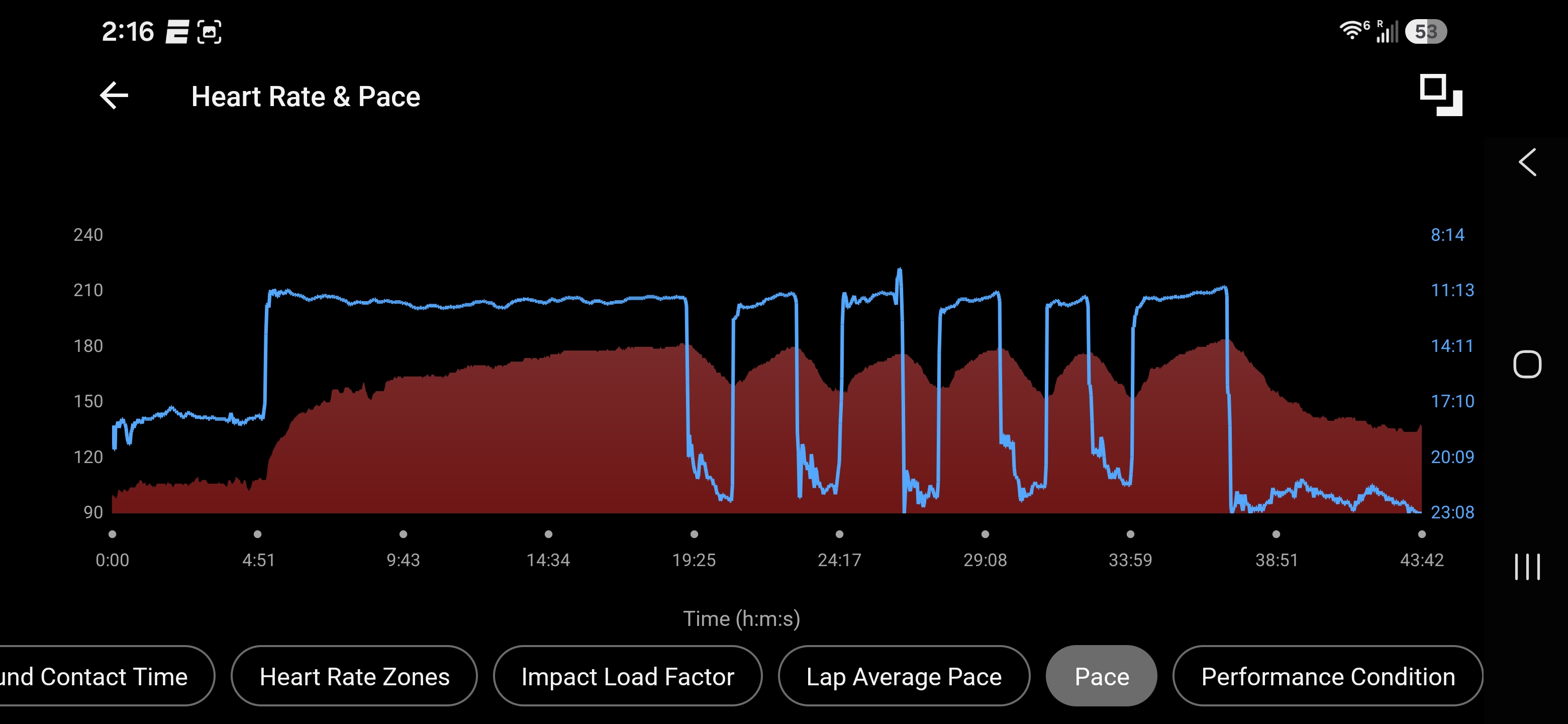
When I started running again, everything felt different.
I stopped several times.
My heart rate kept climbing, and I felt drained.
The first interval had felt controlled.
The second felt like work almost immediately.
By the end, I rated the workout a 10 out of 10.
What confused me most was the walk.
The part of the workout that was supposed to help me recover seemed to make restarting harder.
Maybe the break had nothing to do with it. Maybe I went too hard during the first interval. Maybe fatigue simply caught up with me.
I did not know.
I just knew how it felt.
Before the walk, I had a rhythm.
After 90 seconds, I could not find it again.
First 1.2 miles: 11:42 pace.
Ninety seconds walking.
Second 1.2 miles: 13:48 pace.
That was a pretty dramatic difference for a minute and a half.
Hence the problem.
What I Took From Week 2
If I only looked at the best numbers from this week, everything looked great.
I ran an 11:06 mile.
I ran 1.4 miles continuously.
I made it through 2.4 miles of running during Saturday’s workout, even if the second half was ugly.
There was obvious improvement.
But Saturday was probably the more useful workout.
It reminded me that getting better does not automatically make the next run easier.
A good run does not guarantee another good run two days later.
And a rough run does not erase what happened before it.
I was also starting to change the way I approached training outside of the actual runs.
I moved a workout because I had a migraine instead of forcing it.
I walked on recovery days.
I paid attention to little aches before they became big ones.
I thought about breathing and cadence instead of only pace.
I was slowly learning how to train instead of simply going out and running.
Two weeks into the program, I was definitely improving. I was just beginning to understand that improvement and ease were not the same thing.
Saturday left me wondering why 90 seconds of walking had made the second half feel so much harder.
By the next day, I was already experimenting with something else.
This time, it had nothing to do with pace.


Leave a comment